I watched Medicine for Melancholy with both of the men I dated while living in NYC. The second one was as enamored with the music of the movie as I was. As a gift he gathered all of the tracks from the movie and burned them onto a CD for me. When he couldn’t find a couple of the songs, he Facebook’d Barry Jenkins and asked him where the tracks could be found and got a response! We are no longer together but I still have love for Barry for doing that LOL.
The Changes No One Needs to Know is probably my favorite song from the movie but here are a few others that top the list (and could be found on YouTube). Enjoy!
“I’m driven by a desire to meaningfully provoke others’ curiosity, to paint without cynicism. I still believe in mastery; in the service of imagination it can exceed the limitations of circumstance.” – Kerry James Marshall
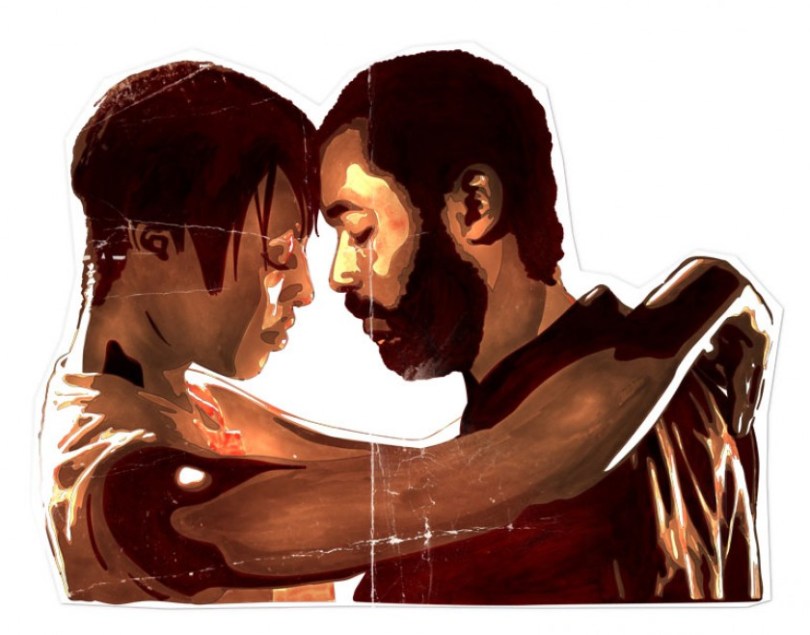
On my more emo, more personal blog, I wrote about how art has made me more aware of the types of intimacy I appreciate. Kerry James Marshall’s Slow Dance is one of those piece. Here he is talking about the painting:
And here he is speaking on the label “black artist”:
Read more about Kerry James Marshall on the PBS Art21 Site
You can read the plot synopsis and my initial thoughts of Nnedi Okorafor’s Akata Witchhere.
I read Akata Witch a few months ago and I meant to write a piece about being a U.S. born Ghanaian soon after. In all honesty I’m a bit worn out by the discussions. African vs. African-American and all of its variations. I’ve reached a point in my life where I’m okay with not fitting into one category or another and I honestly don’t think anyone really does. But if you’re not yet there — if you’re are struggling with your racial/ethnic/cultural identity, I’m going to introduce you to a timeline of events you can expect to go through before you reach a level of not caring:
When you’re in elementary school, you’ll learn the process of Americanizing your name for easy pronunciation. However your first encounter with a substitute teacher will throw you for a loop. The substitute teacher will mispronounce your name and everyone will laugh. Next time you’ll know to arrive at class early to give her your Americanized name or you’ll interrupt her with a loud “HERE!” after she utters the first syllable.
You will notice that, beyond your funny sounding name, you really are different from your schoolmates. This can happen as early as elementary school if your parents boldly denounce assimilation by doing things things like sending you to school with banku and okra soup for lunch.
You will discover that being born in the States but connected to elsewhere makes you kind of unique in a good way. This typically happens in college. You will join cultural organizations on campus where you and your colleagues put together events in the best imitation of those parties and ceremonies your parents have been taking you to since you were a child.
You will visit “home” for the first, maybe second, time in your life and will be reminded that you are different. You’ll be annoyed when strangers call you American girl with absolutely no hesitation. Your annoyance will be furthered by everyone’s obsession with your skin complexion and refusal to relax your hair.
College is over and you are introduced to another type of lonely. It’s no longer as easy to connect with people “like you.” Though you will try with paraphernalia that says what you cannot or by boldly approaching people you hear speaking you mother’s language. If you’re lucky, they’ll be passive in their rejection.
In your loneliness new free time, you discover amazing people who seem to be documenting your experience. You meet characters like Sunny in Akata Witch who live in more than two worlds that seem to be in opposition of each other. You recall each encounter in which you have been told “you’re not _____ enough.” You come to a conclusion that this is all a game of hierarchy built on arbitrary rules of Africanness. You decide that you equally love grilled cheese sandwiches and spinach stew and will never choose one over the other.
How did I forget to mention the music of Restless City?! It’s a great mix of musical styles but I’m going to have to show love for one of the more popular songs from the film: Wale’s My Sweetie
And if you don’t know, Wale’s track samples Bunny Mack’s Let Me Love You:
I don’t remember when I first heard Mack’s version but I consider it a staple of any West African household’s music collection. I was happy to hear our generation’s version of the song in the film.
Beasts of the Southern Wild has been on my radar for a minute now and the trailer has finally arrived! This short from Beasts director, Benh Zeitlin seems to be where the story started:
Literary
Want to get close to some of the greats in contemporary African literature? Farafina Creative Writing Workshop is now accepting applications!
Watch a film multiple times and you can expect to see something new in each viewing. I’ve seen Theodore Witcher’s Love Jones an uncountable amount of times – I’ve moved past the stage of seeing new things into reciting the lines in sync with characters. Baby, you ain’t got to save mine for later, I’d rather have it right now. Nina we’ve already done it before…repeatedly! It’s my go-to movie when I’m in need of a heavy dose of romanticized love.
However, when I’m in need of something a little more relatable, I turn to Medicine for Melancholy – Barry Jenkins’ feature film debut that was released in 2009. I own it on DVD and have seen it about six times with others and on my own. I’ll never get enough of the beautiful images of San Francisco, Wyatt Cenac’s quirkiness, or the film’s amazing soundtrack. I’ve probably noticed something new in each viewing of the film, but it was during the last one that I felt something new.
No I love this city, I hate this city but I love this city. San Francisco is beautiful…You shouldn’t have to be upper middle class to be a part of that. – Micah
I could write for days about my love for NYC, but I could do the same about my hate for this city. I love that NYC has given me so much access to different cultural experiences and that a car doesn’t have to figure into that; but I absolutely hate some of the rude thoughts and behaviors I’ve developed towards the elderly and other slow-moving people on crowded sidewalks. I love that with $30 and a few hours to spend, I can make a round-trip to Philadelphia, Boston, or Washington D.C. I hate that because Manhattan is so expensive to live in, a bus ride to Philadelphia takes almost the same amount of time as my commute to work.
While NYC’s fast-paced rudeness is in direct opposition to the more laid-back ways of San Francisco, the dating scenes of the two cities seem to be similar:
Is it any surprise that folks of color in the scene date outside their race…everything about being indie is all tied to not being black…People call it interracial dating but there’s nothing interracial about it, nine out of ten times it’s somebody of color hanging on to a white person – Micah
It was shortly after this statement that I felt Micah’s loneliness for the first time and I empathized because I’ve been there. I grew up in a city that, from my vantage point, might as well be 99.9% black. Call me naïve, but I never anticipated living anywhere with demographics so different from my hometown. I was completely unprepared to live in cities that are similarly segregated but with fewer black people. It’s not that I didn’t have exposure to non-black people growing up, but in my new surroundings I had to re-examine my ability to navigate interracial relationships. I worked jobs where I had to process the undertones of racism alone. I met black women and men who had no problem identifying as black but felt no need to be connected to other black people; and this crazy idea that black women struggle in trying to partner with black men became a reality.
So I feel like I’m seeing myself on-screen as I watch Micah go from an angry rant about interracial dating to begging JoAnne to stay with him, if only for one more night. I’ve been there. I used to rant to no end about how black men in New York City hated themselves and were only seeking women with physical characteristics that I do not have and refuse to obtain. It was only after a friend checked me about my complaining that I eventually got to my truth: I miss black men.
When I left home, I left all of the men that I love the most: my father, my brother, and the friends I’ve made throughout the years. In an attempt to fill the spaces that Skype and phone conversations can’t replace, I, like Micah, tried to hold on to the few black men I met regardless of our compatibility or their availability. I’ve since realized that relationships built over years cannot easily be replicated in such a short period of time, especially in a city as transient as NYC.
There are so many layers to learning how to survive “the big city.” If there is one thing I absolutely love about New York City, it’s the lessons in relationships and emotional maturity I’ve learned.
Though I have mixed feelings about Restless City, I have much respect for the film’s cinematographer, Bradford Young. Check him in out this video:
We use jazz…as a mantra on how we want to make films…the collective responsibility of how you cannot make jazz alone. And that is sort of what we are trying to bring to the table of filmmaking. – Bradford Young
How can I not have a crush? The analogies to Jazz. The focus on the idea of collaboration and community. The mentions of his inspiration. He’s talking about his work and never says “I”. Amazing.
There is no doubt that writing requires quite a bit of alone time, but according to Kalamu ya Salaam the myth of writing solitude can be damaging for black writers. Read exactly what he means in his essay The Myth of Solitude: No Writer is an Island. Though I can’t relate to some of his generalizations, he does make some good points:
In order to achieve both linear (across generations) and lateral (across cultures) greatness, writers must be both immersed in a specific era/culture and conscious of that era’s relationship to other eras and other cultures. It is not enough to report on or even analyze the news of the day. The ultimate meanings of human existence transcend the specifics of any given moment.
…
In the contemporary United States, “audience” has been collapsed into the concept of consumers, people who literally buy whatever is marketed. That is ultimately a very cynical approach to determining who is one’s audience. To write for and about a specific audience does not necessarily mean writing to sell to that audience. What it does mean is using the culture of the intended audience as the starting point (and hopefully an ending point) for our work.
…
A horrible truth is that too many of us are unprepared to write significant literature because we have no real appreciation of our audience as fellow human beings, as cultural creatures. We know neither history nor contemporary conditions. We talk about “keeping it real” but have no factual knowledge of reality. Thus, we glibly bandy generalizations, utter hip clichés as though they were timeless wisdom, and inevitably offer instant snapshots of the social facade as though they were in-depth investigations of the structure and nature of our social reality — in short, we lie and fantasize.



 Muse & Words