On My Radar: Just A Band: The Movie

Wanuri Kahiu, director of sci-fi short Pumzi, and Anjali Nayar are working on a documentary about Just A Band.  Kahiu describes the project as:

… a kaleidoscopic portrait of four artistically eclectic twenty-somethings who form Kenya’s super nerdy Afro-electro-pop group Just A Band. The film follows them through projects and performances – from their out-of-control street parties in downtown Nairobi to the making of their blaxploitation music-mentry HA-HE, which became Kenya’s first Internet meme.

If you aren’t familiar with Just A Band, check them out:

Web Finds: Emeli Sande, Miranda July & More

Film
I haven’t watched any documentaries on here, but you might find something of interest.

Have you been paying attention to The rise of black lesbian and gay cinema?

Miranda July gives us an awesome tip for those of us who are easily distracted hehe (this is an outtake of The Future).

Literary
The Death of the Black Owned Independent Bookstore, from the AALBC Blog (on the right hand side of your screen, you should see a “Support Black Businesses” image; click it for AALBC’s database of Black owned indie bookstores)

I might as well put Teju Cole in charge of my reading list.  His comments on Michael Ondaatje got me to add Coming Through Slaughter and Running in the Family to my reading list:

For purposes of marketing, writers are designated as poets, novelists, or something else. But writing is about matchmaking, an attempt to marry sensations with apt words. Ondaatje makes language translucent – the exact word, the exact placement of a comma – and the reader has the uncanny feeling of encountering ideas directly. His work is about the things I care most about: memory, threshholds, solitude, work (usually the work of hands), dangerous loves, half-remembered songs and scars of all kinds. It is a particular constellation of thoughts and experiences, so particular to me, I sometimes feel, that I’m unsure if I’m reading or if I’m the one being read.

Other
The words of Emeli Sande are inspiration for any artists (h/t: Concreteloop)

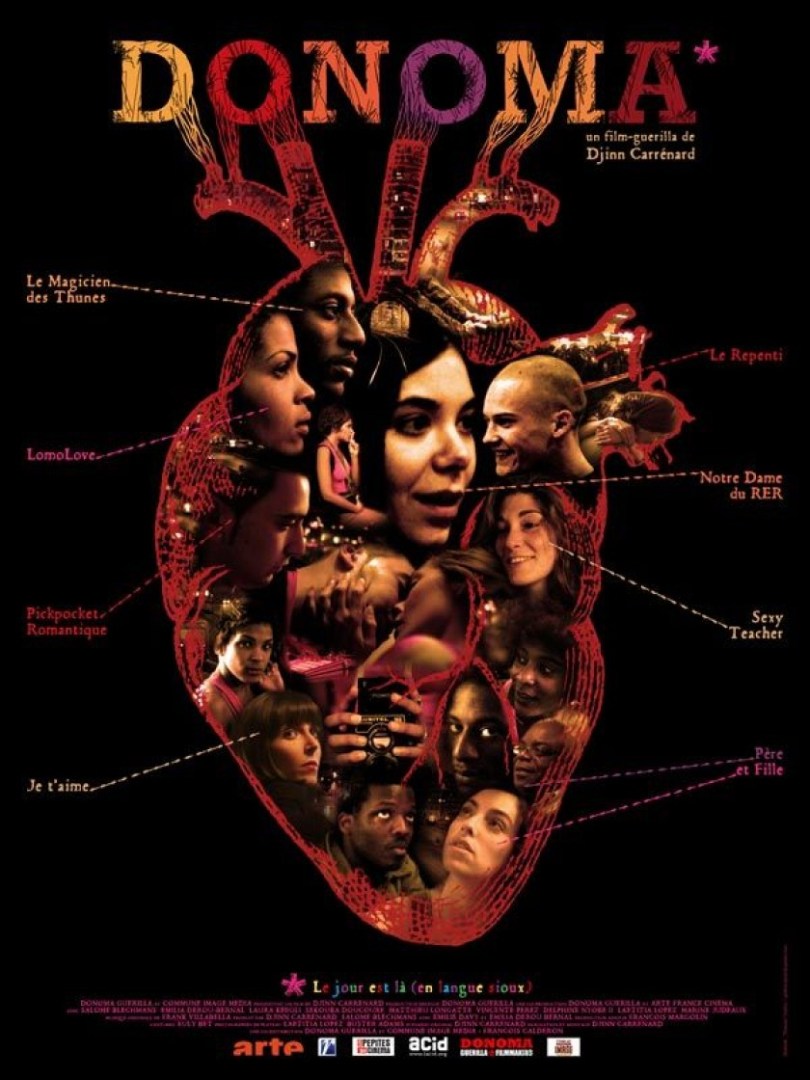
Donoma

I have yet to fully explore this but I’m starting to think that I have an inclination for indie films about love created by black men.  Theodore Witcher’s Love Jones.  Barry Jenkins’ Medicine for MelancholyTerence Nance’s An Oversimplification of Her Beauty.  And now Djinn Carrénard’s Donoma, which I caught at New Directors/New Films:

Donoma exists without a translated trailer and only a few clips with English subtitles.  It was mostly through images that Carrénard got my attention.  When I added Donoma to M&W’s viewing list, I noted “love triptych. Paris.”  Limiting my brief synopsis to three words wasn’t intentional but upon reflection, it uses very little to say a lot as does Carrénard with this feature debut.

Three women, three interwoven storylines create this enticing guerrilla film.

Enticing because Carrénard respectfully breaks the rules of traditional storytelling.  In each of the three stories, Donoma shifts back and forth between present and past sometimes quickly and with little or no transition.  He, then, ends the film without any resolve but in a fashion I haven’t been able to appropriately name in brief.  Rather than easing you out of the story or offering some metaphoric conclusion with an obvious meaning, Carrénard ends the film in the midst of great emotion.

Though the non-traditional aspects of the film and 133-minute runtime can be mentally demanding, Donoma allows you to consider your own ideas about love without being overwhelmed.  Carrénard, who was studying philosophy when he realized he was a filmmaker, makes this allowance by introducing his thoughts on love very subtly throughout the film.

Though the three stories are meant to discuss different types of love (the passionate, the day-to-day, and the religious kind), one audience member noted, during the post-screening Q&A, that all three women were disturbed in some way.  In response to this Carrénard first joked that this was a result of having two sisters, then more seriously he responded that because he is a man, anything he creates involving women will be misogynistic.  It’s only upon reviewing his work is he able to see the misogyny.  Though misogyny is an intense word, I think Carrénard’s point was to acknowledge the male privilege he holds while creating his female characters.

Continuing on the point of saying a lot with a little, it’s been reported that Donoma was created on a budget of $200.  In the post-screening Q&A, Carrénard explained how he was able to make the film on such little money.  Everything that he used to make the film was either borrowed or gifted.  He only came up with the $200 figure after being pressed at Cannes about the film budget and being reminded by a crew member about the tuxedo – a $200 tuxedo was used in a scene that was later cut from the film.  (If this isn’t inspiration for every artist, I don’t know what is.)

For those curious about the film’s name:  Donoma is a Sioux word meaning the day has come (according to Carrénard) or similarly, sight of the sun (according to a bunch of random internet sources).  Carrénard chose to use a Sioux word because the name of his birth country, Ayiti (Haiti), has origins in a language of people indigenous to the Americas as well.

There is no word on an American distributor as of yet but I’m hopeful since it did go to theaters in France after its Cannes debut.  If you’re in the NYC area this week, you can catch it at BAM’s Ghett’Out Film Festival.

Event Recap: National Black Writers’ Conference 2012

I went to this year’s National Black Writers’ Conference specifically for the panel entitled Migration and Cultural Memory in the Literature of Black Writers

I was late to the panel and though I did miss some stuff, I think I got the goods:

Nana Ekua Brew-Hammond on migration:
We often talk about black migration in a physical sense (Africa -> the West; southern US -> northern US; the West -> Africa) but we also migrate in a mental sense. We migrate daily from our communities to [white] institutions (schools, workplaces, etc.), where we have to adjust the way we speak, dress, etc. As writers, however we migrate, be it mental or physical, it ends up on the page.

She also talked about the contradictory images of Africa she received growing up in the U.S. She would see her parents’ very cosmopolitan photos from Ghana and hear her parents talking about how wonderful Ghana is (though not discussing why they are in the States if Ghana is so wonderful) and at the same time she would see images of “starving Ethiopians” and various people trying to save them. Though I’m a few years younger than Nana Ekua, I completely relate. My mother has the awesome images of herself and her friends from before she emigrated from Ghana to the U.S. but outside of my family, I only received very tragic images of Africa. I’m sure this is something a lot of black people throughout the diaspora can relate to.

A moment of elitism during the panel:
During the Q&A, a man stood up, noted that he’d published several books and asked the panelists for their advice to up and coming writers. One panelist caused a little controversy when she responded that everyone was claiming to be a writer and the importance was in the study — writers need to study and develop technique. She saw the increasing number of self-published works as pollution. Ouch. The man who initiated the discussion took it personally which I understand. I agree that study and technique are important but I have no beef with the self-publishing world or with the supposed universal claim of “writer.”

A fact I was unaware of:
One of the last events of Saturday’s programming was a conversation between Esther Armah and Tavis Smiley. In a story Tavis was sharing about Toni Morrison he said that she didn’t get started until she was 39 or 40. I searched the internet for her writing history, when I got home, and discovered that her first novel was published when she was about 40 years old. I had no idea! but it’s inspiring.

For images of the conference, check the NBWC Facebook Page. And here is another short recap of the conference.

Web Finds: Loneliness, Shyness & More

Film

My crush persists: AFFRM recently launched their website

In an interview with Film Society Lincoln Center, Terence Nance shows some love for Ghana and notes books as a source of inspiration.

Zadie Smith’s On Beauty is being adapted into a film by Kasi Lemmons!

Literary

A reading list for young men of color

I’m adding Emily White’s Lonely to my to-read list because of mensah demary’s words

James Baldwin in a 1984 interview with Jordan Elgrably. Baldwin gives us so many gems, but here are a few highlights:

Thank God for visual artists:

INTERVIEWER

Was there anyone to guide you?

BALDWIN

I remember standing on a street corner with the black painter Beauford Delaney down in the Village, waiting for the light to change, and he pointed down and said, “Look.” I looked and all I saw was water. And he said, “Look again,” which I did, and I saw oil on the water and the city reflected in the puddle. It was a great revelation to me. I can’t explain it. He taught me how to see, and how to trust what I saw. Painters have often taught writers how to see. And once you’ve had that experience, you see differently.

A Word to the shy:

INTERVIEWER

Did what you wanted to write about come easily to you from the start?

BALDWIN

I had to be released from a terrible shyness—an illusion that I could hide anything from anybody.

Other
I was going to excerpt some of the highlights of this article but I would’ve had to repost the whole damn thing. Check out Teju Cole enlightening everybody on the White Savior Industrial Complex.

I was browsing Facebook when I came across this song (via Alternate Takes: a new jazz blog):


sound familiar? The greats inspire the greats.

Silver Sparrow

Silver Sparrow is a story about family — about relationships between husband and wife, between sisters, and between mother and daughter.  It’s about many of the relationships through which I have experienced family.

I was born between a vibrant, older sister and a charming, younger brother.  We were raised by a shy yet comedic father and a spirited and bold mother.  I love them all.  But familial relationships are never perfect and coming to terms with this fact is part of the transition from childhood to adulthood.  Tayari Jones’s Silver Sparrow was a perfect literary piece for my own transition.  Here are some of her words that I made sure to take note of:

Read More »

Web Finds: SXSW Recaps, African Film Library & More

Film

African Film Library has launched!

Colorlines & Shadow & Act recap SXSW

S&A has several reviews for films shown at SXSW including Gimme the Loot (which won the Grand Jury Award for Narrative Feature) and The Last Fall; but I just wanted to highlight a bit of music from Colorlines’ recap:

MUSIC: The female hip-duo TheeSatisfaction has been performing at SXSW since 2010 but this year they’re on everyones radar: they’ve been featured everywhere from the NY Times to the LA Times and everything in between including what seems like every music blog on the internet. Thee Satisfaction raps about politics, justice, sexuality but they describe their blend of music the best: “funk-psychedelic feminista sci-fi epics with the warmth and depth of Black Jazz and Sunday morning soul, frosted with icy raps that evoke equal parts Elaine Brown, Ursula Rucker and Q-Tip.”

Literary

First I read this then I went here. Instant love.  I look forward to reading more.

Other

More from SXSW: videos and photos of the All Africa Showcase hosted by Spinlet

I’ve been feeling like a grown up jamming to Gregory Porter’s Be Good.  The official video, directed by Pierre Bennu has been released.  Watch Below:

“The dance of love is something that can be done alone but it is also fun with somebody else,” says Bennu. “I wanted to show two characters; one who was so busy dancing alone, never looking to have a partner… and another so desperate for love that he would do whatever it took to get it. What that character finally realizes is that all he needed to offer forth was himself.”

Event Recap: Artists at Work: An Afternoon with Edwidge Danticat

Last weekend, Philadelphia’s Art Sanctuary hosted Artists at Work: An Afternoon with Edwidge Danticat. The event featured a panel discussion moderated by April Silver with panelists: spoken word artist Michelle Myers, visual artist James E. Claibrone Jr., bassist Jonathan Michel, and writer Edwidge Danticat.

A few insights I gained from the panel:

On speaking for/with a community:

I see myself as speaking as part of a chorus — the more voices that join, the more enlightened we are… saying that I am the voice of a non-monolithic, complex people silences other people’s voices. – Edwidge

Join the chorus. Don’t allow anyone to silence your voice and don’t attempt to silence anyone else’s voice.

When people lay claim, they sometimes want to dictate what I write about… – Michelle

I get excited when someone is able to put my thoughts into words but then sometimes I have expectations for them to continue to do this. It’s an unfair burden for artists.

We internalize negative images of ourselves [from popular media] and then celebrate it… [We need] to invest in and create righteous art/images – James

*a lightbulb moment for me*. When James made this comment I realized that countering negative stereotypes is not just about being accepted by the “other” but also about not internalizing negativity.

Advice to “aspiring” artists on the importance of study and discipline:

Study is paradigm to what we do…discipline comes from the love of what we do… Learn from the elders; we are not innovators, we are continuing the tradition – Jonathan Michel

I love Jonathan for this comment because it made me realize that my writing is bigger than me. Writing is something that comes naturally to me and I indulge in it as a form of therapy. But if I’m going to acknowledge writing as my calling then I need to recognize the duty that comes with it. *a true lesson in humility*

As a follow-up to Jonathan’s comment on learning from the elders: Study their grace, not just their work, but the way their personhood embodies their work. – Edwidge

This was an important message for me to hear. Though my name means grace I’ve let my ego and my insecurities create a version of myself that is anything but graceful and disconnected form my work.

*
This was originally posted on The G is for Grace